10 Porutham Explained – Which 5 Matter Most for Marriage?
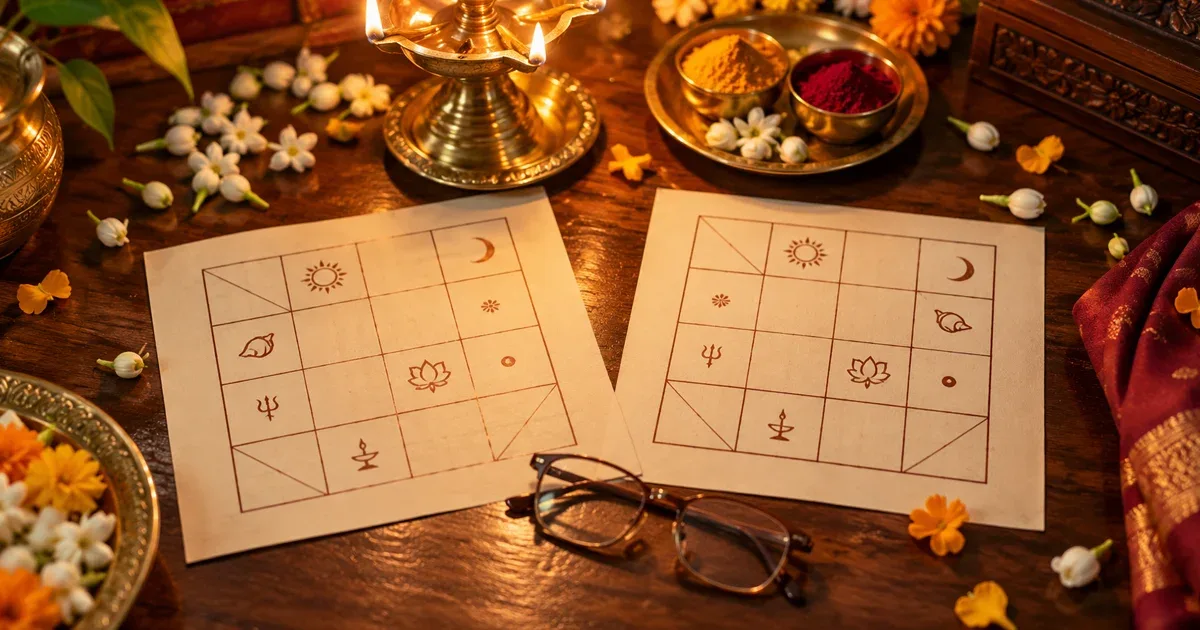
The horoscope arrives on WhatsApp late on a Thursday evening, forwarded by an aunt with the message "Good family. Please check." By the weekend, three people have given three different answers: one says the match is fine, one says it is "only six", and one says the rajju is wrong. If you have been there, you have probably asked the same question every Tamil family asks: what is the main porutham for marriage in Tamil tradition, and how much should a single number decide?
This guide goes through all ten poruthams in plain English, explains the five that families tend to watch most closely, and shows how to read a score without either ignoring it or panicking over it.
What is porutham, and why do Tamil families check it?
Porutham means "agreement" or "fit". In marriage matching, it is a comparison of the bride's and the groom's birth stars (natchathiram) and moon signs (rasi). Ten traditional tests are applied, and each one that agrees counts as a porutham.
For many Hindu Tamil families, this is the first step of any proposal. It usually happens before photos are discussed seriously and long before the two families sit down together. A good porutham does not make a marriage, and nobody serious claims it does. But it gives elders a shared, familiar way to say "yes, let us talk further" or "let us think again". If your family follows these customs, our page on Hindu Tamil matrimony explains how horoscopes fit into a search on DailyMatrimony.
One detail surprises people. The count always starts from the bride's star and goes to the groom's. Swap the two and the result changes, sometimes a lot. We show an example of this further down.
The 10 poruthams at a glance
Here is what each porutham is traditionally said to look at, and the rule our free tool applies. "Count" means counting stars (or rasis) from the bride's to the groom's, including both ends, so the same star counts as 1.
| Porutham | Traditionally said to look at | When the tool marks it as matching |
|---|---|---|
| Dinam | Health and peace in daily life | Star count of 2, 4, 6, 8, 9, 11, 13, 15, 17, 18, 20, 22, 24, 26 or 27 |
| Ganam | Temperament (deva, manushya or rakshasa) | Same gana, or deva with manushya in either direction. |
| Mahendram | Children and the family's growth | Star count of 4, 7, 10, 13, 16, 19, 22 or 25 |
| Stree Deergham | The wife's long life and wellbeing | Star count of 13 or more. From 7 to 12 it is average |
| Yoni | Physical closeness, through each star's animal | Always, except for seven pairs of animal enemies |
| Rasi | Harmony between the two families | Same rasi, or the groom's rasi 7th, 9th, 10th or 11th from the bride's |
| Rasi Athipathi | Friendship between the planets ruling the two rasis | Same ruling planet, friends both ways, or friendly one way and neutral the other. Neutral both ways, or hostile one way and neutral the other, is average |
| Vasiyam | Natural attraction and affection | Either rasi is traditionally drawn to the other |
| Rajju | A long married life, and the husband's wellbeing | The two stars belong to different rajju groups |
| Vedhai | Freedom from obstacles between the two stars | Always, except for 15 fixed star pairs |
A few of these rules are not the same in every family. Some astrologers read ganam the other way round, and the vasiyam list differs slightly between almanacs. Where practice varies, the tool follows the common published table, and your own astrologer's reading should come first.
The main porutham for marriage in Tamil tradition: dinam, ganam, yoni, rasi and rajju
Ask ten elders which poruthams matter most and you will hear several lists. The set heard most often names five: dinam, ganam, yoni, rasi and rajju. Our tool lists these five first, in their own section, for that reason.
The logic behind this choice is easy to follow. Dinam is about everyday life together. Ganam is about whether two temperaments can live under one roof. Yoni covers the physical side of a marriage, which families rarely say out loud but still care about. Rasi looks at how the two families will get on. Rajju, the most serious of all, is linked with a long and safe married life.
The other five still count towards the score. Some families give mahendram and stree deergham extra weight because they relate to children and to the bride's wellbeing. If your family follows a different list, that is not a mistake. It is simply one of the many places where Tamil practice varies from home to home.
Rajju and vedhai: the two doshams families rarely overlook
Two poruthams are treated differently from the rest. When rajju or vedhai does not agree, it is called a dosham, a fault. In many families, a dosham ends the discussion whatever the total score. That is why the tool shows a separate warning for them, apart from the score.
Rajju divides the 27 stars into five groups, named after parts of the body from head to feet. If the bride and groom fall in the same group, rajju fails. Vedhai is a list of 15 star pairs that are said to block each other, such as Ashwini and Kettai, or Rohini and Swathi.
Here is something you may not know. In the tables the tool uses, every vedhai pair is also a same-rajju pair. So a vedhai dosham never appears alone; the rajju warning always comes with it. Our guide to rajju porutham, its groups and the remedies families discuss goes into this in more detail.
There is one well-known exception. When the bride and groom share the same star, eight stars are accepted: Rohini, Thiruvathirai, Magam, Hastham, Visakam, Thiruvonam, Uthrattathi and Revathi. For other shared stars, the tool marks dinam and rajju as average when both padams are known and different, and as not matching otherwise.
How many poruthams are enough? Reading a score out of 10
Each porutham that matches adds one point. An average result adds half a point. The tool then gives a score out of 10 and a short label:
- 8 or more: excellent match
- 6 to 7.5: good match
- 4 to 5.5: average match
- Below 4: weak match
- Rajju or vedhai fails: "Dosham found", shown instead of the label, whatever the score
Many families treat six as a comfortable minimum. Others care far more about which poruthams agree than how many. A score of 7 with all five main poruthams in place often feels better to elders than an 8 that misses rajju.
Two worked examples
Take a bride whose star is Ashwini (Mesham rasi) and a groom whose star is Thiruvonam (Magaram rasi). Nine of the ten poruthams agree, and the tenth, rasi athipathi, is average: Saturn counts Mars as an enemy, while Mars is neutral towards Saturn. The score is 9½ and there is no dosham, so most families would happily continue.
Now take a bride with Rohini (Rishabam) and a groom with Hastham (Kanni). The score is 6½, with dinam, rasi and rajju not matching and stree deergham average. Swap them, so the bride is Hastham and the groom Rohini, and the score rises to 8. But both stars sit in the Kanta rajju group, so the dosham warning appears either way. This is the kind of result that is worth showing to an astrologer rather than deciding alone.
When a match scores low: options families consider
A low score or a dosham is a reason to pause, not a reason to panic. Before you reply to the other family, work through these steps:
- Check the details. Make sure both stars are correct. If a star spans two rasis, such as Karthigai or Uthiram, the padam decides the rasi. One wrong padam can change all three rasi-based results: rasi, rasi athipathi and vasiyam.
- Check the direction. Confirm that the bride's star was entered as the bride's. It sounds obvious, but forwarded horoscopes get mixed up.
- Look at which poruthams failed. A miss in vasiyam is read very differently from a miss in rajju.
- Ask for a full reading. The ten poruthams use only the stars and rasis. An astrologer reading the complete jathagams will also look at the planets, the dasa periods and doshams such as chevvai dosham, which the tool does not cover.
- Talk as a family. Some families stop at a dosham. Others proceed after an astrologer's advice and a parikaram (remedy). Both are choices families make, and neither is ours to judge.
Check your own stars in minutes
If you know both stars, you can see all ten results now with our free porutham tool. It needs no login and stores nothing you enter. If you want to see how every star relates to the others, the natchathira porutham chart for all 27 stars is a good next step, and our post on how to read the 27-star chart explains it.
When you are ready to look for a match, you can create a free profile and add your natchathiram and rasi. Families who check porutham will see them when they view your profile.
Free to join
Find your Tamil life partner
Create a free profile in a few minutes, and decide for yourself who sees your photos and contact details.
Register FreeOn this page
- What is porutham, and why do Tamil families check it?
- The 10 poruthams at a glance
- The main porutham for marriage in Tamil tradition: dinam, ganam, yoni, rasi and rajju
- Rajju and vedhai: the two doshams families rarely overlook
- How many poruthams are enough? Reading a score out of 10
- Two worked examples
- When a match scores low: options families consider
- Check your own stars in minutes
Free to join
Find your Tamil life partner
Create a free profile in a few minutes, and decide for yourself who sees your photos and contact details.
Register FreeRelated Articles
All articles
Natchathira Porutham Chart – All 27 Stars
A plain guide to the 27-star porutham chart: each star's gana, yoni and rajju, how to read the tables, and which pairs families avoid.
Rajju Porutham: Meaning, Dosha and Parikaram
The five rajju groups and their stars, why a same-rajju match worries elders, the exceptions, and what to ask an astrologer.
திருமண பொருத்தம் பார்ப்பது எப்படி? முழு வழிகாட்டி
நட்சத்திரம், பாதம், ராசி முதல் ரஜ்ஜு, வேதை, மதிப்பெண் வரை: திருமணப் பொருத்தத்தைப் படிப்படியாகப் புரிந்துகொள்ளுங்கள்.